Implementing artificial intelligence in organisations often sparks a familiar question:
“How much human effort will this replace?”
I hear it in boardrooms and project rooms alike CIOs, CEOs, COOs asking for ROI and capacity. And I hear the quieter version from teams:
“Is my job next?”
Both concerns are valid. But the way we frame the question shapes the entire strategy and the culture that follows.
Because when we ask “Will AI replace humans?” we’re often assuming something that isn’t true.
The hidden assumption
We assume:
All processes are the same
Most work is low risk and safe to automate end-to-end
Governance and accountability are optional
We can accept decisions made by machines without a clear owner
In the real world, that doesn’t hold.
Not all workflows are created equal and the difference isn’t technology; it’s risk, accountability, and trust.
Fei Fei Li put it bluntly: treating AI as if it’s entirely about automation is a misconception; it’s also about interpreting complex data and supporting better decisions. (Stanford HAI)
1. What leaders should ask instead
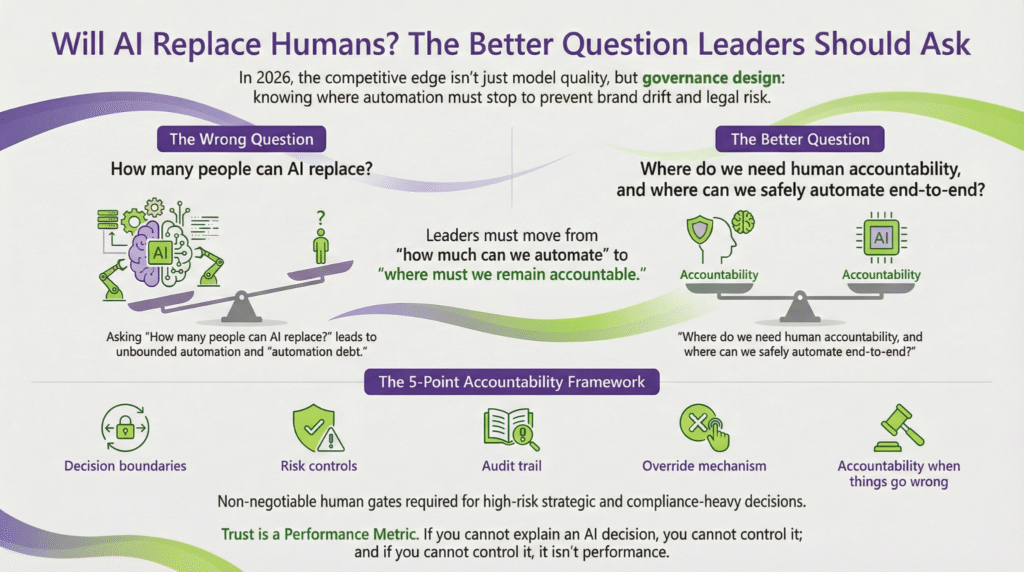
When leaders ask “How many people can this replace?” they’re often measuring AI like a labour saving machine. A better lens is to measure AI like a decision system.
The better question
Instead of “How many people can AI replace?” ask:
“Where do we need human accountability and where can we safely automate end to end?”
Accountability can’t be automated.
Because once AI starts influencing outcomes, someone must own:
the decision boundaries
the risk controls
the audit trail
the override mechanism
the accountability when things go wrong
Where AI can safely automate
AI is exceptional at repeatable, testable, low risk tasks, such as:
routing, triage, and classification
summarising calls/meetings and drafting responses
extracting fields from documents (forms, emails, invoices)
first pass analysis and prioritisation
Why does risk matter? AI learns patterns from historical data but history doesn’t contain intent, ethics, nuance, or accountability.
So even when models are “accurate on average,” they can still:
miss context and optimise for the wrong metric
amplify bias embedded in the data
fail on edge cases
confidently produce incorrect outputs (hallucinations)
IBM’s guidance on hallucinations is practical: human review is a backstop to filter and correct errors when stakes matter. (IBM)
Where removing humans becomes exposure
High stakes workflows look very different:
credit/loan decisions
fraud and investigations
hiring and performance decisions
health or safety outcomes
public sector decisions affecting citizens
compliance and regulated communications
A simple tier model: speed with trust
One practical way to guide design decisions is to classify workflows by risk and required oversight:
Tier 1 (low risk): automate end to end + periodic audits
Tier 3 (high risk): human approval + strong auditability + override + documented governance (aligned to NIST / ISO 42001)
2. Real world examples from our implementations
Here are a few practical examples across industries where you can design checks, validate outcomes quickly, and roll back safely when something’s off while keeping human accountability where it matters.
Example A: Large Australian multi contact centre organisation
In one contact centre transformation for a large Australian organisation operating multiple contact centres, the core challenge wasn’t a lack of technology it was fragmentation: multiple CRMs/case systems, multiple carriers/CCaaS platforms, and dispersed customer interaction history.
The key Human in the Loop lesson: even with self service voice AI and automation, we did not remove humans where accountability mattered. Humans remained responsible for:
policy based decisions (exceptions, waivers, outcomes)
QA sampling, coaching, and performance management
Example B: Local government / council service delivery (secure internal AI assistant)
In one local government implementation, we built a secure internal AI assistant designed to help staff find answers across policies, projects, and archived emails using natural language and returning traceable responses with citations back to source material.
To keep governance intact, we designed for human oversight and enterprise controls by default:
Human in the loop approvals before AI generated business cases, communications, or reports can be used
This pattern accelerates staff productivity while ensuring the organisation remains accountable for decisions and communications.
Example C: Financial services (onboarding and credit decisions)
In a mid to large financial services environment, onboarding and credit decisions involve high volumes of documents and repetitive checks but the final outcome directly impacts someone’s financial life.
Where AI adds value (safe automation + controls):
extract and summarise key details from application packs (IDs, payslips, bank statements, contracts)
classify requests (new loan, refinance, hardship, disputes) and route to the right queue
generate a structured case brief for assessors (risks, anomalies, missing documents, suggested next steps)
run consistency checks (e.g., mismatched names, address history gaps, unusual income patterns)
Where humans stay in the loop (accountability):
final approval/decline decisions
exceptions, hardship and vulnerability assessments
any outcome that affects rights, eligibility, pricing, or compliance
3. What employees should do (instead of worry)
If you’re an employee asking “Will AI replace my job?” here’s the best self-check:
The one question to ask yourself
Am I mostly doing repeatable, testable, low risk tasks?
If the honest answer is yes, don’t panic upskill. Because the work won’t disappear; it will shift from doing the task to supervising, improving, validating, and governing the system that does it.
You don’t need to become a data scientist. But you do need to become someone who can:
write better instructions and acceptance criteria
evaluate AI outputs critically
understand risk, bias, and failure modes
design guardrails and escalation paths
use AI to deliver outcomes faster
The three modes of modern AI operations
Human out of the loop: automation runs end to end (low risk)
Human on the loop: AI runs, humans monitor and intervene on exceptions
Human in the loop: human approval required (high stakes)
Think aviation: autopilot handles the routine, but pilots remain responsible monitoring systems, managing exceptions, and taking over when risk rises.
So in most enterprises, the direction will be: less “human in the loop” everywhere, more “human on the loop” by default, and almost never “no human accountability.”
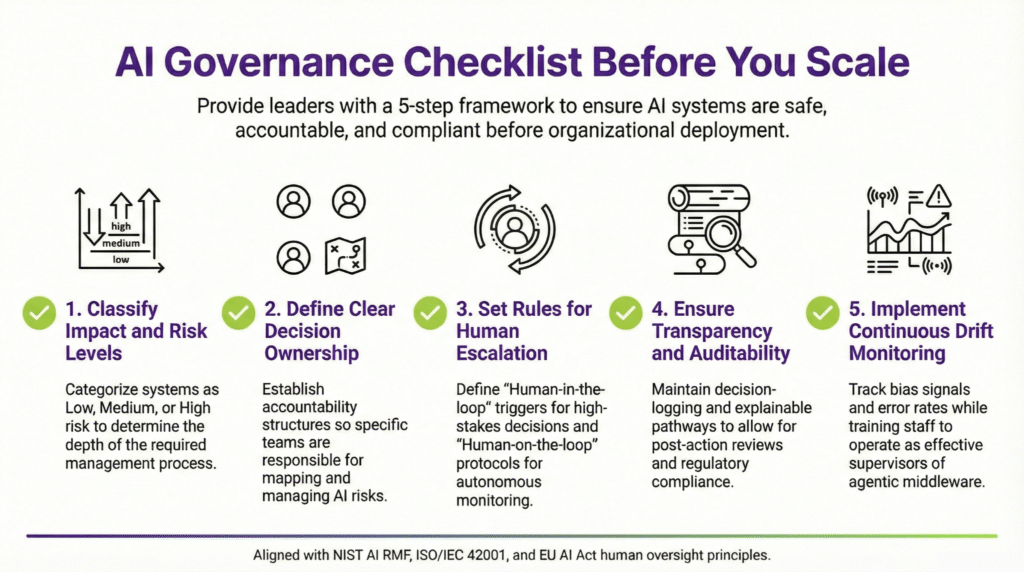
4. A simple governance checklist for leaders
If you’re scaling AI across the business, here’s a practical checklist you can apply to any use case (before you scale it):
Impact classification: low / medium / high risk
Decision ownership: who is accountable for outcomes?
Escalation rules: when does AI hand off to humans?
Auditability: are actions logged and explainable enough for review?
Override mechanism: can humans stop or reverse decisions quickly?
Training: equip staff to operate “on the loop,” not just “use the tool”
This isn’t just “nice to have” it’s increasingly aligned to how governance frameworks and emerging regulation describe safe AI deployment (see NIST AI RMF, ISO/IEC 42001, and the EU AI Act’s emphasis on human oversight).
5. Closing thought
So, will AI completely remove humans in the loop?
In low risk, repeatable work: yes, increasingly.
In high stakes, high accountability work: no. And it shouldn’t.
The winning organisations won’t be the ones with the most automation. They’ll be the ones with the best governance design: clear accountability, safe escalation, strong auditability, and people who know how to operate AI responsibly.
At ITKnocks, we are more than an IT consulting company; we’re your strategic partner in business evolution. With a global footprint and a passion for technology, we craft innovative solutions, ensuring your success. Join us on a journey of excellence, where collaboration meets cutting-edge IT expertise.